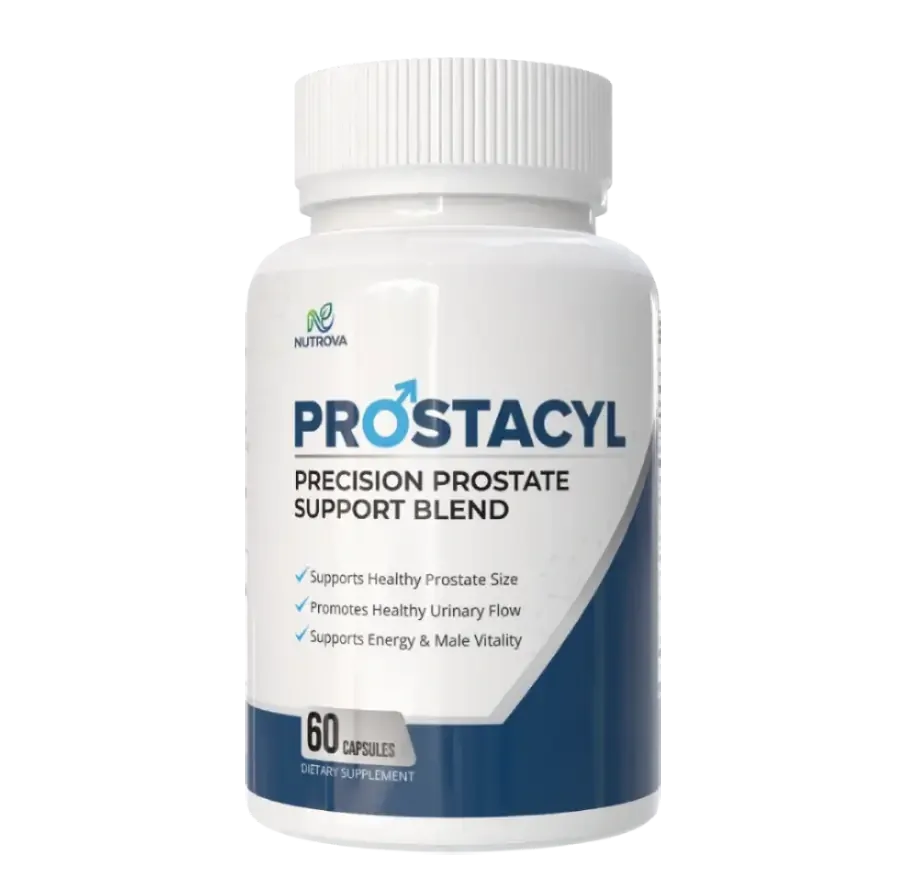
U.S. stocking partner for Prostacyl · Independent label reading
Prostacyl: daily prostate support and urinary comfort in two capsules
A daily capsule for men, sold to support prostate health and urinary comfort. The serving is two capsules with 6 to 8 ounces of water, and each 60-capsule bottle lasts 30 days. Every one of the nine label ingredients carries its amount, from saw palmetto at 300 mg and pygeum bark at 200 mg to pumpkin seed at 100 mg. One bottle is $69; six are $49 each. It is a dietary supplement, not a treatment for any prostate condition, so new or changing urinary symptoms go to a doctor first.
One bottle, 60 capsules a bottle, two a day. The panel this page transcribes is printed on the back of the wrap.
Prostacyl in 60 seconds
Prostacyl is a capsule dietary supplement for men, sold to support prostate health and urinary comfort. One serving is two capsules a day with 6 to 8 ounces of water, so a 60-capsule bottle covers a month. Its label lists nine ingredients with an amount for each, including saw palmetto, pygeum and pumpkin seed, and no proprietary blend. One bottle is $69; six are $49 each.
This is an independent information desk. It sells nothing itself, it publishes what the supplied material actually says, and where a figure was never supplied it says so rather than filling the gap with something plausible. On most products in this series that policy produces a page full of holes. This one is different, and the difference is worth stating before anything else: the label prints an amount for every single ingredient, so the work here is arithmetic rather than absence.
9Panel rows, every one with an amount
0Proprietary blends
2Capsules a day, with water
$49A bottle on the six-bottle pack
Each of the nine rows has its own section on the ingredients page, and the pricing page covers the packs and the refund terms. If you take a prostate medicine or have urinary symptoms that have not been checked, speak to your doctor before you start.
The product at a glance
Eight facts, each one taken from the label or the material supplied with it. Where a row gives two figures, the merchant printed two figures.
Form
Capsules, 60 a bottle
Serving
2 capsules daily with 6–8 oz water
Supply
30 days a bottle
Panel rows
9, every one with an amount
Proprietary blend
None — nothing is hidden behind a total
Capsule
Gelatin, so not vegetarian
Guarantee
60 days or 90 — the page prints both
Lowest price
$49 a bottle on the six-pack
The full label wrap as supplied: suggested use and the caution block on the left, the front panel in the middle, and the complete nine-row Supplement Facts panel on the right. Every amount on this site is read off the right-hand third of this image. One thing to note about the document itself — it is pre-press artwork rather than a photograph of a printed bottle, and it still carries the production instruction for the barcode area.
Compare that image with what the sales page does. The seller pack records that the sales page’s What’s inside heading printed no panel at all, and listed six of the nine names in what amounted to a reference list. The label wins wherever the two disagree, and here the label wins by a wide margin. The uncomfortable consequence is that the one document which would let a buyer check this product is the one place the merchant does not show them.
808.8 mgDeclared in a serving, which is 404.4 mg a capsule
0.5 mgLycopene delivered, against 15 mg in the trial
6.0 mgPygeum sterols delivered, against 13.0 mg in the trial dose
$49Lowest published price a bottle, on the six-pack
Prostacyl — 60 capsules, two a dayNine ingredients, each with a printed amount and no proprietary blend — the most transparent panel in this series. 60 or 90 days — the page prints both. From $49 a bottle on the six-pack.
This is the section that would normally be an argument about a missing document. Here it is a transcription, and the transcription is the best thing about the product. A dietary supplement sold in the United States carries a Supplement Facts panel, and the panel has a fixed shape: a serving size, a servings-per-container figure, then one row for each dietary ingredient with its name on the left and its quantity per serving on the right. The rule that sets that shape is 21 CFR 101.36.
Prostacyl prints all of it. Nine ingredients, nine amounts, a serving size of 2 capsules and 30 servings a container. Tap any row to read what it delivers.
Supplement FactsServing Size: 2 Capsules · Servings Per Container: 30
Tap any row
** Daily Value (DV) not established. Other Ingredients: Gelatin (capsule), Brown Rice Flour. Distributed By: Nutrova, Tallmadge, OH 44278. Transcribed from the label artwork supplied. Every amount above is printed; none is derived.
Read the right-hand column top to bottom. There is a figure in every cell. No row says proprietary blend, no group of ingredients shares a single weight, and nothing is deferred to a sales page. Two rows go further and print the percentage the extract is standardised to, which is the information that makes the rest of this page possible: without the 3% on the pygeum row and the 5% on the lycopene row, neither of those sums could be done by anyone outside the company.
The panel adds up, which is a check worth doing
Sum the nine printed amounts and a serving comes to 808.8 mg: 25 + 13.8 + 300 + 200 + 100 + 100 + 50 + 10 + 10. That is 404.4 mg a capsule at the printed two-capsule serving. A size 0 capsule holds roughly 400 to 500 mg of powder, so the fill is plausible and close to capacity, with the brown rice flour making up the remainder. The panel is internally consistent with itself and with the physical object it describes, and that is not true of every label this desk reads.
What this label does right, said plainly and first
Nine dietary ingredients, and nine printed amounts. Not one row hides behind a total.
No proprietary blend. The device that lets a label name six things and weigh them once is not used here at all.
Botanical species named where a species exists: Serenoa repens, Vitis vinifera, Cucurbita moschata, Lycopersicum esculentum, and Pygeum africanum.
Plant parts named: fruit, bark, seed, seed, leaf. A reader can tell which part of the plant was extracted without asking anyone.
Two rows carry a standardisation percentage — pygeum at 3% phytosterols and lycopene at 5%. Those two percentages are what make the arithmetic further down this page possible at all.
A serving size and a servings-per-container figure, both printed: 2 capsules and 30.
An Other Ingredients line: Gelatin (capsule), Brown Rice Flour. Short, specific, and enough to tell a reader the capsule is not vegetarian.
A complete caution block, printed on the label rather than left to the sales page, naming a dose limit and the four groups who should ask a physician first.
Three storage and safety lines, correctly drafted, including the safety-seal instruction.
The FDA disclaimer in full, in capitals, in the form the rule asks for.
A properly qualified country-of-origin mark: made in the USA, using foreign and U.S. ingredients. That is the correct way to make this claim.
A real named distributor with a place of business and an email: Nutrova, Tallmadge, OH 44278, USA.
What it still leaves open
The vitamin E percentage. 167% DV is printed for a synthetic form that delivers nearer 83% on the conversion NIH publishes.
The saw palmetto row carries no standardisation, and it is the largest botanical on the panel at 300 mg.
No standardisation for the grape seed extract or the pumpkin seed extract either.
No stated reason for grape seed extract being on a prostate panel at all.
The refund window is printed as 60 days in one place and 90 in another.
The three-bottle pack is shown with no total printed, and $119 is struck through beside the one-bottle price with nothing to support it.
A badge in the marketing set reads Vegetarian over a gelatin capsule, and another reads Doctor Formulated with no doctor named anywhere.
The label this desk was shown is pre-press artwork, not a photograph of a printed bottle: it still carries the barcode instruction meant for whoever sets the file.
Twelve credits and eight open questions is an unusual balance for this series, and it is the reason the score further down is the highest one on record here. The label page transcribes every other line on the wrap — the directions, the caution block, the storage lines, the Other Ingredients line, the distributor and the three foot-of-label marks — and numbers all eighteen findings.
01The seller pack says there is no panel. The label artwork carries a full one
This is where the reading starts, because it decides which document governs. The seller pack records that the sales page's What’s inside heading did not print a panel on the fetch, and lists Pygeum, saw palmetto, pumpkin seed, stinging nettle, boron and lycopene as names appearing in a reference list rather than as a declared formula. The label artwork supplied in the same pack carries a complete, fully quantified Supplement Facts panel with nine rows, every one of them bearing an amount. The label wins. It is transcribed on this site exactly as printed, and it is the best label in this series: nine ingredients, nine amounts, no proprietary blend, nothing hidden behind a total. What it means for a reader is narrower and more awkward: the merchant’s own sales page omits the panel its own label carries, so the document that would let a buyer check the product is the one place they are least likely to look.
02The vitamin E percentage is roughly double what the form delivers
The panel declares Vitamin E (as dl-alpha tocopheryl acetate) 25 mg, 167% DV. The arithmetic behind 167% is 25 divided by the 15 mg Daily Value, which is 166.7%. That treats the synthetic form as if it were worth the same per milligram as the natural one, and it is not. The prefix dl- marks it as all rac-alpha-tocopherol, a mixture of all eight stereoisomers of which the body retains four. NIH’s Office of Dietary Supplements states the conversion directly: 1 mg of alpha-tocopherol equals 1 mg of natural RRR-alpha-tocopherol or 2 mg of synthetic all rac, so 30 mg of the synthetic form would be needed for 100% DV. On that conversion 25 mg of this form supplies about 12.5 mg of alpha-tocopherol, which is about 83% of the Daily Value — close to half of the 167% printed. A second, smaller reduction follows if the 25 mg is the weight of the acetate ester rather than tocopherol equivalents: the ester is heavier than the free alcohol (472.74 against 430.71 g/mol), which would put the figure nearer 11.4 mg, about 76%. This desk publishes 83% as the headline because it rests on the conversion ODS states in so many words. Either way the printed figure overstates what the serving delivers, and nothing about this is unsafe: 25 mg is a long way below the 1,000 mg upper limit. It is an accuracy finding, not a safety one.
03Lycopene 5% of 10 mg is 0.5 mg, and that is the whole row
The panel prints Lycopene 5% (Lycopersicum esculentum) (tomato) 10 mg. Read the row carefully: the 5% is the standardisation of the extract, so the 10 mg is 10 mg of a preparation that is 5% lycopene. The lycopene itself is 10 × 0.05 = 0.5 mg. Set that against the published work. The commonly cited BPH trial (Schwarz and colleagues, Journal of Nutrition, 2008) gave 15 mg of lycopene a day for six months to 40 men. This serving is one thirtieth of that. Set it against food instead and the gap widens: USDA’s own figures put one cup of canned tomato juice at 21.96 mg of lycopene and one cup of canned tomato puree at 54.39 mg. A cup of tomato juice carries about 44 times the lycopene in a day of this product; a cup of puree, about 109 times. The row is not wrong and it is not hidden — the label discloses the percentage, which many do not. It simply does not amount to much.
04Two hundred milligrams of pygeum that delivers less sterol than a hundred
This is the most instructive row on the label, because the bigger number loses. The panel prints Pygeum africanum Extract (bark) 200 mg, std. to 3% phytosterols. The phytosterols are the measured constituent, so the serving delivers 200 × 0.03 = 6.0 mg of them. The clinical literature on pygeum uses extract standardised to 13% total sterols, at around 100 mg a day or 50 mg twice daily. One hundred milligrams at 13% delivers 13 mg of sterols. So this product prints twice the milligram figure of the trial dose and delivers roughly 46% of the sterols — about 2.2 times less. That is the whole argument for reading a standardisation percentage before a milligram figure, in one row, on one label. Credit where it is due: this label prints the percentage, which is what makes the calculation possible. A label that printed only “Pygeum 200 mg” would look better and tell you less.
Nothing in this section is a ceiling, an estimate or a guess. Every figure below is either an amount printed on the panel or that printed amount multiplied by a standardisation percentage printed on the same panel. Where a comparison needs a figure from outside the label — a Daily Value, an upper limit, a trial dose, a USDA food figure — the source is named in the same sentence.
The four rows whose meaning changes under arithmetic, with the working shown.
The row, as printed
What the arithmetic gives
What the published work used
Vitamin E (as dl-alpha tocopheryl acetate) 25 mg, 167% DV printed
The 167% is 25 ÷ 15. NIH’s Office of Dietary Supplements converts 2 mg of the synthetic all rac form to 1 mg of alpha-tocopherol, so 25 mg supplies about 12.5 mg — roughly 83% of the Daily Value.
100% of the Daily Value is 15 mg of alpha-tocopherol. The upper limit is 1,000 mg a day, so nothing here is a safety finding.
Pygeum africanum Extract (bark) 200 mg, std. to 3% phytosterols
The phytosterols are the measured constituent, so the serving delivers 200 × 0.03 = 6.0 mg.
Trials use extract standardised to 13% total sterols at about 100 mg a day, which is 13.0 mg of sterols. Twice the milligrams, under half the sterols.
The 5% is the standardisation, so the lycopene is 10 × 0.05 = 0.5 mg.
The commonly cited BPH trial gave 15 mg a day for 6 months to 40 men. USDA puts one cup of canned tomato juice at 21.96 mg — about 44 times a day of this product.
Nettle Extract (leaf) 50 mg
No multiplication to do. The variable on this row is the plant part, and the label names it, which is good practice and the reason the mismatch is visible.
The BPH literature is on root: aqueous root extract at 360 mg a day for six months, and methanol root extract to 1,200 mg. Nettle leaf has its own literature, and none of it concerns the prostate.
Printed against delivered, and delivered against the published doseNothing on this page is a ceiling. Every amount on this label is printed, so every figure here is either that printed amount or that printed amount multiplied by a printed standardisation percentage. Where this desk has had to go outside the label — to a Daily Value, an upper limit, a trial dose or a USDA food figure — the source is named in the same sentence.
Saw palmetto, as printed300 mg
Pygeum, as printed200 mg
Pygeum, phytosterols delivered6 mg
Pygeum sterols in the trial dose13 mg
Nettle leaf, as printed50 mg
Nettle root in the trials360 mg
Lycopene preparation, as printed10 mg
Lycopene actually delivered0.5 mg
Lycopene in the trial dose15 mg
0.5 mg5 mg50 mg500 mg
Green bars are this product. Grey bars are the dose used in the published work. Read the three pairs: the pygeum row prints 200 mg and delivers 6 mg of the measured constituent against the trial's 13 mg; the nettle row prints 50 mg of leaf against 360 mg of root; the lycopene row prints 10 mg of a 5% preparation, which is 0.5 mg of lycopene, against 15 mg. Every figure is printed on the label or is the printed figure multiplied by the printed standardisation.
What this section is, and what it is not
None of the four rows above is mislabelled, and none of them is a safety finding. The label prints the amount, prints the standardisation where there is one, and prints the plant part. Every figure in the table is the merchant’s own number, or two of the merchant’s own numbers multiplied together. The finding is that the serving delivers substantially less of the measured constituent than the published work used, and that no reader could discover this without doing the arithmetic themselves.Each row is set out one at a time here, with the standardisation, the part and the comparison in full.
Nine rows, and what each one is carrying
For a botanical, the name alone carries almost no information: the same plant name covers a raw dried powder, a concentrate and a standardised extract that can differ by more than an order of magnitude in whatever is being measured. This label does better than a name on seven of its nine rows. Tap any card for the detail.
Two rows deserve singling out for opposite reasons. Pygeum is the most instructive row on the panel, because the bigger milligram figure loses: 200 mg at 3% delivers less sterol than the 100 mg at 13% the trials use, and the label printing its percentage is the only reason anyone can see that. Grape seed extract is the row with no account at all — 100 mg of an antioxidant studied in cardiovascular contexts, sitting on a prostate panel with no stated reason. What each row is supposed to be doing is set out here.
This desk’s score, and why the best label here still gets 2.9
Six dimensions, marked out of five, published with the reasoning rather than as a number on its own. A page that only attacked the best label in a series would be advocacy, and less useful than one that keeps score honestly, so the credits are marked in the same table as the failures.
Ingredient disclosureNine rows, nine amounts, no proprietary blend, species and parts named
Label documentationA full label wrap with panel, directions, cautions and a distributor — but it is pre-press artwork
Dose against evidenceLycopene at a thirtieth, nettle the wrong part, pygeum under half the sterols, saw palmetto unstandardised
Claim accuracyThe B6 percentage is right; the vitamin E percentage is roughly double what the form delivers
Badge honestyVegetarian contradicts a gelatin capsule; Doctor Formulated names no doctor
Price and refund termsTwo of three packs priced, but the refund window is printed two different ways
2.92.9 is the highest score this desk has given in the series, and the reason is the first row. This label does the thing almost none of the others do: it prints an amount for every single ingredient, names the species and the plant part, and standardises two of them. That is what a label is for. The score is held down by what the amounts turn out to say once you do the arithmetic, and by a set of badges that the label itself contradicts.
The first row is a five, and it is a five for a reason that has nothing to do with generosity: ingredient disclosure is the thing a label exists to do, and this one does it completely. The second row is a four, held back only because the document supplied is pre-press artwork rather than a printed bottle. Then the score falls, and it falls on the three dimensions that arithmetic reaches.
Dose against evidence scores one, because four of nine rows land far below the published doses. Claim accuracy scores two: the B6 percentage is right and the vitamin E percentage is roughly double what the form delivers. Badge honesty also scores one, and that one is the easiest of all of them to fix — a Vegetarian badge over a gelatin capsule and a Doctor Formulated badge with no doctor named are both decisions somebody made about artwork, not facts about a formula. All ten supplied badges are set out here.
Packs, and the one row that cannot be completed
Three packs are offered and two of them can be priced. The middle one cannot, because the sales page shows it without a total.
One month30 capsules · 30 days
1 bottle
30 capsules in total · 30 days at two capsules daily, the serving the label prints
Pack size1 of 6 bottles
$69.00$69.00 a bottle · $2.30 a day
30 days at two capsules daily
$119 is printed struck through beside it, with nothing to support it
Shipping cost not published for this pack
Refund window printed as 60 days in one place and 90 in another
Every pack: sealed bottles · 60 or 90 days — the page prints both · returns to 1370 Avenue of the Americas, Floor 4, New York, NY 10019, USA
The one-bottle row uses the printed $69 over 30 days, which is about $2.30 a day. The six-bottle row is the merchant’s own figure of $49 each: six times $49 is $294, and $294 across 180 days is about $1.63 a day. That arithmetic is this desk’s and is labelled as such. The three-bottle row is blank because a figure between $69 and $49 a bottle would be a guess, and the $119 struck through beside the one-bottle price is used nowhere on this site, because nothing supplied shows it was ever charged. The pricing page prints the table with the empty cells left empty.
Settle the refund window before you order, not after
The sales page prints two different windows. A 60-day promise appears alongside the money-back badge, and a 90-day figure appears on the refund contact line on the same page. Both cannot be the term. Confirm the window at the live checkout and in the refund policy before you order, and keep a copy of whichever one you were shown.
Day 0You orderWrite down which refund window you were shown, 60 days or 90, and keep a copy of the page. That is the single most useful minute you will spend on this product.
Days 1–7You startTwo capsules daily with 6 to 8 oz of water, at the same time each day. This is printed on the label, not just the sales page.
Weeks 2–4The merchant's own medianThe supplied review summary says most buyers waited two to four weeks to form a view.
Day 30One bottle goneA natural review point, and inside both candidate refund windows.
Day 60The shorter window closesIf 60 days is the term, this is the last day.
Day 90The longer window closesIf 90 days is the term, this is the last day. Do not plan on it without confirming it first.
What people search for before they buy this
These are the query shapes people type about this product, grouped, with each one pointed at the page here that answers it. Several of them have a short answer and three of them are worth giving straight away.
How much lycopene is in it: 0.5 mg, not the 10 mg printed, because the row is a 5% preparation. Does it have a Supplement Facts panel: yes, a complete one, which is unusual enough in this series to be the headline. Is it vegetarian: no — the capsule is gelatin, whatever the badge says.
Prostacyl: common questions
Fourteen questions, phrased the way people type them. Each answer carries the figure it rests on and names the source for anything from outside the label. Type to filter.
prostacyl supplement facts panel
There is one, and it is complete. The label artwork carries a fully quantified Supplement Facts panel with 9 rows, every one of them bearing an amount, a serving size of 2 capsules, 30 servings a container, and no proprietary blend. That is the most transparent label this desk has read in this series. The awkward part is where it sits: the merchant’s own sales page omits the panel its own label carries. The panel is transcribed in full here.
prostacyl ingredients list
Nine, in the order the panel prints them: Vitamin E 25 mg, Vitamin B6 13.8 mg, Saw Palmetto Extract 300 mg, Pygeum africanum Extract 200 mg, Grape Seed Extract 100 mg, Pumpkin Seed Extract 100 mg, Nettle Extract 50 mg, Boron 10 mg and Lycopene 5% at 10 mg. Other Ingredients: Gelatin (capsule), Brown Rice Flour. Each of the nine is set out row by row here.
prostacyl lycopene amount
Read the row carefully, because the answer is not 10 mg. The panel prints Lycopene 5% … 10 mg, and the 5% is the standardisation of the preparation. The lycopene itself is 10 × 0.05 = 0.5 mg. The commonly cited BPH trial gave 15 mg a day for 6 months to 40 men, which is 30 times more. USDA puts one cup of canned tomato juice at 21.96 mg.
what is lycopene 5 percent 10 mg
It is 10 mg of an extract that is 5% lycopene by weight, so it supplies 0.5 mg of lycopene. The same convention applies to the pygeum row: 200 mg standardised to 3% phytosterols supplies 6.0 mg of phytosterols. Both percentages are printed on the label, which is the only reason either sum can be done. A label that printed the milligram figure alone would look better and tell you less.
how much saw palmetto is in prostacyl
300 mg of saw palmetto extract, from the fruit of Serenoa repens, and no standardisation is printed for it. The CAMUS trial randomised 369 men, started at 320 mg a day, doubled at 24 weeks and tripled at 48, ran 72 weeks, and found no difference from placebo at any dose: the AUA Symptom Index fell 2.20 points on saw palmetto and 2.99 on placebo, P = .91. This product sits below even the starting arm.
dl alpha tocopheryl acetate vs natural vitamin e
That prefix is the whole of this finding. dl- marks the synthetic all rac form, a mixture of all eight stereoisomers of which the body retains four. NIH’s Office of Dietary Supplements states the conversion in so many words: 1 mg of alpha-tocopherol equals 1 mg of natural RRR-alpha-tocopherol or 2 mg of the synthetic form. So the 25 mg printed supplies about 12.5 mg, which is roughly 83% of the Daily Value rather than the 167% printed.
vitamin b6 812 percent daily value too much
The percentage is arithmetically correct: 13.8 divided by the 1.7 mg Daily Value is 811.8%, and the label prints 812%. Credit that. Two upper limits are worth knowing beside it. The US Food and Nutrition Board sets 100 mg a day, so this serving is about 14% of it. The European Food Safety Authority set an adult limit of 12 mg a day in 2023, and on that figure this serving is about 15% above it. The safety page sets both out.
is 10 mg boron a day safe
Boron has no Daily Value, because the Food and Nutrition Board found the data insufficient to set one, so the ** on that row is correct. It does have a Tolerable Upper Intake Level for adults of 20 mg a day, and this serving is half of it. Total intake from food and supplements together runs about 1.0 to 1.5 mg a day, so one serving is roughly seven to ten times a typical day. NIH records no adverse effects within the upper limit and no known clinically relevant drug interactions.
is prostacyl vegetarian gelatin capsule
No. The label’s Other Ingredients line reads Gelatin (capsule), Brown Rice Flour., and gelatin is an animal product. The label does not use the word vegetarian either way; it discloses the material and lets you draw the conclusion, which is the right way round. One of the compact badges supplied with the marketing set reads Vegetarian, and the label contradicts it.
prostacyl price per bottle
One bottle is $69, with $119 printed struck through beside it and nothing supplied to show $119 was ever charged. Six bottles are named at $49 each with free shipping against $19.99, which multiplies to $294 — this desk’s arithmetic on the merchant’s own figure. The three-bottle pack is shown with no total printed, so that row is left empty. The pricing table shows the working.
prostacyl refund policy 60 or 90 days
Both figures are printed, which is the problem. A 60-day promise appears beside the money-back badge, and a 90-day figure appears on the refund contact line on the same page. Both cannot be the term, and this site will not choose between them, because choosing would mean inventing one. Confirm the window at the live checkout, and keep a copy of whatever you were shown. The refund procedure is set out here.
who makes prostacyl nutrova
The label prints Distributed By: Nutrova, Tallmadge, OH 44278, USA, with the email [email protected]. A named distributor with a place of business, printed on the label itself, is more than most products in this series manage, and it is recorded here as a credit. It does not match either address this site publishes: the retailer’s office is in New York and its returns address is a different New York building. Who is who is set out on the about page.
is prostacyl legit or a scam
This desk does not use that word; it keeps score, and the score here is 2.9 out of 5, the highest it has given in this series. The reason is the label: nine ingredients, nine printed amounts, no blend, species and parts named, two standardisations, a full caution block and a real distributor. What holds the score down is what those amounts turn out to say once the arithmetic is done, and a set of badges the label itself contradicts. The reviews page covers the supplied testimonials separately.
prostacyl supplement does it work
Nothing supplied answers that. No clinical trial of this product exists in the material, and no document claims one. What can be checked is each row against the published work on that ingredient, and four of the nine land well short: lycopene at a thirtieth of the trial dose, pygeum at under half the sterols, nettle leaf where the trials use root, and saw palmetto below the lowest arm of a trial that found nothing at three doses. What each row is supposed to be doing is set out here.
References
Every source below was opened and read. Where a statement on this page rests on a regulation, a Daily Value, an upper limit, a trial dose or a food composition figure, the document it rests on is listed here. Nothing is cited from memory.
Sixty capsules, two a day, thirty days a bottle. The Supplement Facts panel declares nine ingredients and nine amounts, with no proprietary blend — the most transparent label in this series. Four of those nine rows change meaning once the arithmetic is done, and all four sums are shown in full. One bottle is $69; six are $49 each. The refund window is printed as 60 days in one place and 90 in another.
Returns to 1370 Avenue of the Americas, Floor 4, New York, NY 10019, USA
Prices as printed on the sales page, as of October 12, 2026: one bottle $69, six bottles $49 each with free shipping. The three-bottle total is not published, so it is left blank rather than estimated. The refund window is printed as 60 days in one place and 90 in another — confirm it at the checkout. Questions first? Every published contact route is here.
The label artwork, read at 2× and transcribed character for character. Where the label and the marketing disagree, the label is printed.
The seller pack, quoted rather than paraphrased, and identified as marketing wherever it is used.
The published sources listed in the references on this page. Every one was opened and read; none is cited from memory.
The arithmetic, shown in full. Every amount on this panel is printed, so the figures here are conversions of printed amounts with the working given, never ceilings and never estimates.
Nothing else. Any fact that was not supplied is recorded as not published rather than filled in.
Last updated October 12, 2026. A highlighted slot is a value no human has supplied yet. Who reviews these pages?
Prostacyl — price shown at checkout60 capsules · two a day · nine ingredients, all nine with amounts